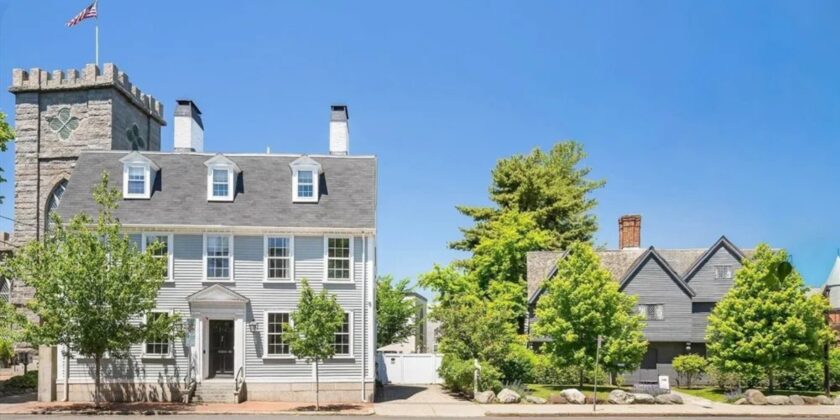
Buyers searching for distinctive historic properties in established New England towns may find strong appeal in a six-bedroom home that recently entered the Salem market.
Property Details and Current Pricing
The Lindall-Gibbs-Osgood House, a 4,670-square-foot Georgian-style residence, is offered at $1,875,000. It first appeared on the market in mid-May at a price just under two million dollars before the figure was adjusted downward.
Built in 1755, the three-story structure features traditional clapboard siding and sits directly beside the Jonathan Corwin House, known locally as the Witch House. This adjacency places the property in a high-visibility location within Salem’s historic core.
Renovation History and Current Configuration
Current owners acquired the home for $608,437 in 2013 and completed a three-year renovation that modernized electrical, plumbing, and HVAC systems while preserving original architectural elements. The work created three en-suite bedrooms on the second floor and converted the third floor into a private owner suite containing a primary bedroom, luxury bath, and walk-in closet.
The main level includes a reception foyer, two parlors each equipped with wood-burning fireplaces, a formal dining room, and a powder room. The kitchen retains its original hearth and beehive oven while incorporating a commercial-grade refrigerator.
Short-Term Rental and Investment Potential
The listing highlights the property’s suitability for short-term rental use. The renovation initially prepared the home to operate as an owner-occupied bed-and-breakfast, a format that aligns with Salem permitting requirements. Three second-floor bedrooms with private baths provide guest accommodations, while the third-floor suite offers separation for an owner or manager.
Real estate professionals note that properties with this level of historic character and central location often attract interest from buyers seeking both personal residence and income-generating potential.
Location Advantages in the McIntyre Historic District
The home lies within the McIntyre Historic District and is flanked by the Witch House on one side and a Unitarian Universalist Church on the other. This setting delivers a quiet backyard despite proximity to tourist foot traffic. The private yard is described as suitable for entertaining.
Daily necessities remain walkable: restaurants and shops are nearby, and the commuter rail station is a ten-minute walk away. That rail line reaches Boston in approximately thirty minutes, offering practical access for commuters or visitors who prefer not to drive.
Market Context for Historic Salem Properties
Salem continues to draw residents and visitors interested in its preserved architecture and walkable neighborhoods. Homes that combine updated mechanical systems with period details frequently appeal to both end users and investors evaluating the local housing market.
Andrew Pike of the Persac Group, the listing agent, observes that the residence suits multiple buyer profiles: those wanting to experience the Salem lifestyle firsthand, individuals considering a small hospitality business, or buyers seeking convenient rail access to Boston while maintaining a calmer residential setting outside peak tourist periods.
Key Features at a Glance
- Six bedrooms and five bathrooms across 4,670 square feet
- Three en-suite guest rooms on the second floor
- Owner suite with luxury bath and walk-in closet on the third floor
- Original kitchen hearth paired with modern appliances
- Two main-level parlors with fireplaces
- Private backyard in a high-traffic yet quiet pocket
- Ten-minute walk to commuter rail with thirty-minute service to Boston
Public records trace ownership through Mary Lindall in the eighteenth century, later Mercy Gibbs who operated a shop on the premises, and the Osgood family who held the property for 122 years beginning in 1815. Subsequent uses included the local Red Cross chapter and a law firm office before the 2013 purchase.
For buyers evaluating historic-home purchases, the combination of documented provenance, recent systems upgrades, and established neighborhood context provides measurable context within the broader Salem real estate landscape.